+971501502596
 Order@elfbardubai.ae
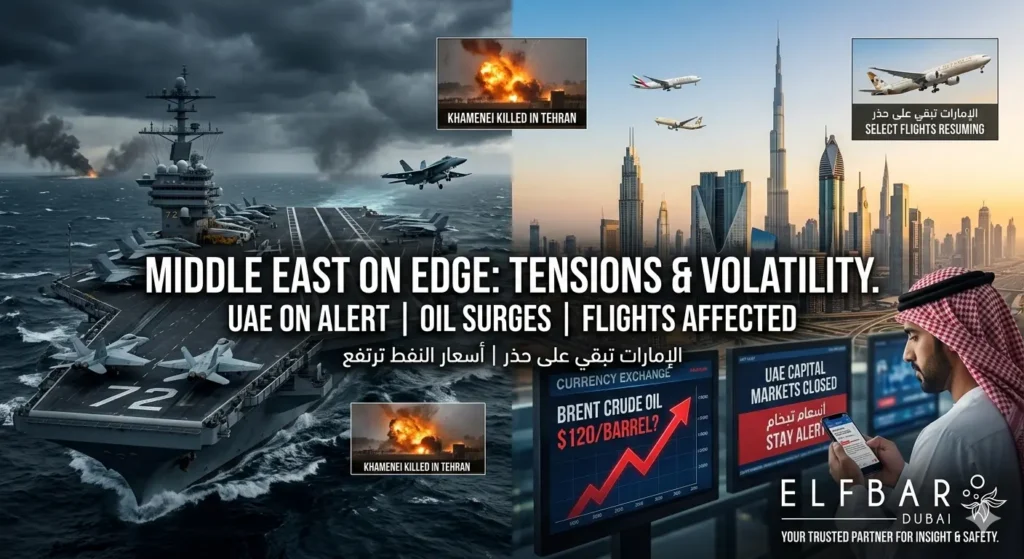
March 2026 has brought a “Shamaal” (storm) of geopolitical uncertainty to the Arabian Gulf. With the recent escalation between the US, Israel, and Iran, the region finds itself at a critical crossroads. For the residents and business owners of the UAE, from the bustling streets of Deira to the high-rises of Dubai Marina, the question on everyone’s mind is: “Kayf al-haal?” (How is the situation?) and how will this affect our pockets? As new strikes impact the region and oil prices threaten to breach the $120 mark, understanding the economic Maktoub (destiny) of the Emirates is more important than ever.
1. The Black Gold Fever: Oil Volatility at $120+
In the UAE, oil isn’t just a commodity; it’s the heartbeat of the global markets. The recent “Zilzal” (earthquake) in diplomacy has sent Brent Crude soaring past $81.
- The Hormuz Factor: Much of the world’s oil passes through the Strait of Hormuz. With Iran’s recent strikes, the fear of a blockade is real. Analysts warn that if the Sikka (path) is closed, we could see prices hitting $150 or even $180.
- The Ripple Effect: When oil prices rise, the cost of Shahn (shipping) follows. For an e-commerce hub like Dubai, this means the cost of importing goods—from electronics to your favorite vape kits—could see a significant hike.
2. Impact on the UAE Economy: A Test of Resilience
The UAE has always been a Mishkaat (lantern) of stability in a volatile region. However, no economy is an island.
- Financial Markets: The closure of the UAE capital markets on Monday and Tuesday was a “Darura” (necessity) to prevent panic selling. This move by the authorities shows a proactive approach to protecting the Maal (wealth) of investors.
- Tourism and Aviation: Dubai International (DXB) is the world’s gateway. With flight cancellations extending, the Siyaha (tourism) sector—a massive pillar of our GDP—is feeling the heat. While some flights are resuming, the uncertainty makes travelers hesitant.
- Real Estate: While the Aqar (real estate) market in Dubai is historically “Hadeed” (iron-strong), prolonged regional tension might slow down the influx of foreign investors who seek a Malja’ (refuge) in our luxury properties.
3. How It Affects the ‘Nas’ (The People)
Behind the big headlines are the everyday lives of the people living in the seven Emirates.
- Cost of Living: High oil prices lead to “Ghala’a” (inflation). When transport costs rise, the price of Khobz (bread), milk, and petrol at the Adnoc or Enoc stations follows. Residents may need to tighten their Hizam (belts) in the coming months.
- Supply Chain Delays: For those of us waiting for “Talabat” (orders) from overseas, expect delays. Whether it’s a new iPhone or wholesale stock for your shop, the disrupted shipping lanes mean patience is a Fadhila (virtue).
- Job Market Security: While the UAE government has a massive Ihtiyati (reserve) to keep the economy afloat, private sectors tied to international trade might see a temporary “Waqf” (pause) in aggressive hiring.
4. Why the UAE Remains a Safe Haven
Despite the Fitna (turmoil) surrounding us, the UAE’s leadership has proven time and again that they can navigate through “Amwaj” (waves) of crisis.
- Strategic Neutrality: The UAE’s diplomatic stance is focused on Salam (peace). By staying alert but calm, the government ensures that internal security remains “Mumtaz” (excellent).
- Economic Diversification: Unlike decades ago, Dubai’s economy is now powered by trade, tech, and logistics—not just oil. This makes us “Qawi” (strong) enough to withstand global shocks that would break other nations.
5. Advice for Business Owners and Residents
In times of Azma (crisis), wisdom is your best asset.
- Avoid ‘Isha’at’ (Rumors): Stick to official sources like WAM or Gulf News. Don’t let WhatsApp forwards dictate your financial decisions.
- Inventory Management: If you run a business like elfbardubai.ae, ensure your Makhzan (warehouse) is stocked. Relying on “Just-in-Time” delivery during a war is risky.
- Financial Prudence: Now is the time for Tawfir (saving). Keep a liquid reserve of Dirhams for emergencies.
- Community Spirit: We are all in this together. Supporting local businesses helps keep the Souq (market) alive.
Conclusion: Looking Toward the ‘Mustaqbal’ (Future)
The current situation between the US, Israel, and Iran is a dark chapter, but the story of the UAE is one of overcoming odds. While the volatility in oil and the “Tashannuj” (tension) in the air are real, the foundations of our nation are built on solid ground.
At elfbardubai.ae, we believe in the resilience of this “Ard” (land). We are monitoring the situation closely to ensure our customers get the best service despite the logistical hurdles. We pray for Aman (safety) for all and a swift return to stability.
Stay alert, stay safe, and keep moving forward.