 Order@elfbardubai.ae

18+ notice: This information is for adults aged 18 and over. The sale of nicotine products to under-18s is prohibited in the UAE.
Nicotine strength tells you how much nicotine is dissolved in a liquid. It is usually written in milligrams per millilitre (mg/ml) or as a percentage, and 20 mg/ml is the same as 2%.
In the UAE, the national standard for electronic nicotine products caps e-liquid at 20 mg/ml. Any figure above that, such as “5%” or “50 mg”, does not meet the UAE rule.
This guide shows you how to read the number on a label, how to convert between units, what the law says, and which points the official texts leave open.
Key facts
- The UAE standard UAE.S 5030:2018 says nicotine in electronic liquid “shall be less than or equal to 20 milligrams per milliliter” (section 4.2.4).
- Cabinet Resolution No. 5 of 2019 made that standard mandatory across the UAE (Article 1).
- In percentage terms, 20 mg/ml is 2%, 12 mg/ml is 1.2%, 6 mg/ml is 0.6% and 3 mg/ml is 0.3% (Business Companion, UK Trading Standards).
- Every UAE pack must carry a warning that the product “contains nicotine which causes severe addiction” (UAE.S 5030, section 5.2.8).
- The World Health Organization states that “nicotine is highly addictive and harmful to health” (WHO).
Start here: what does the number on the label mean?
Find the figure printed on the label in the left column. The table tells you what it means and which part of this guide covers it.
| What you see | What it means | Go to |
|---|---|---|
| 20 mg/ml | 20 mg of nicotine in each millilitre. This is the UAE maximum. | Part 1 |
| 2% | The same strength as 20 mg/ml, written as a percentage. | Part 2 |
| 5% or 50 mg | About 50 mg/ml, which is above the UAE limit. | Part 3 |
| “20mg” with no “per ml” | Either 20 mg/ml or the total nicotine in the product. | Part 1, point 3 |
| 6 mg per pouch | The amount in one nicotine pouch. It is a different measurement. | Part 1, point 4 |
Part 1: The units you will see on a label
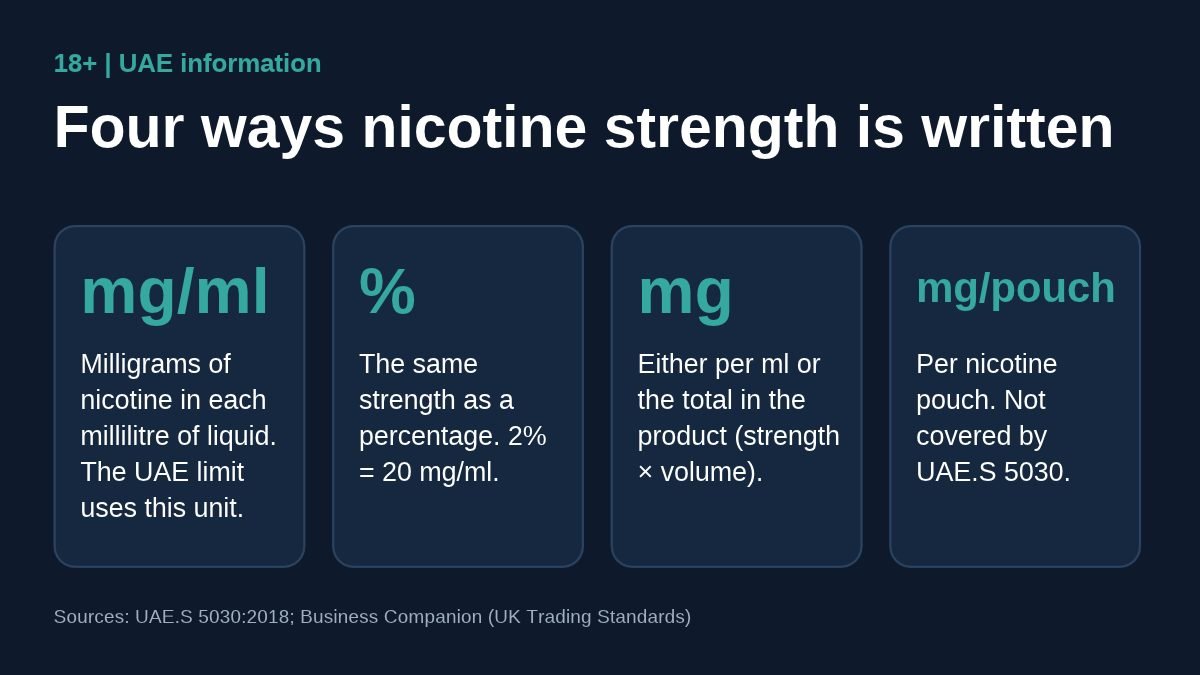
Nicotine strength is a concentration. It describes how much nicotine sits in a set amount of liquid, not how much is in the whole device or bottle. You will usually meet one of four ways of writing it.
1. Milligrams per millilitre (mg/ml)
This is the standard regulatory unit. A label reading 20 mg/ml means each millilitre of liquid contains 20 milligrams of nicotine. UAE.S 5030 sets its limit in this unit, and so do other regulators. Canada’s federal rules, for example, say a vaping product “must not contain nicotine in a concentration that exceeds 20 mg/mL”.
In short: mg/ml is the unit the UAE limit is written in, so it is the easiest one to check.
2. Percentage (%)
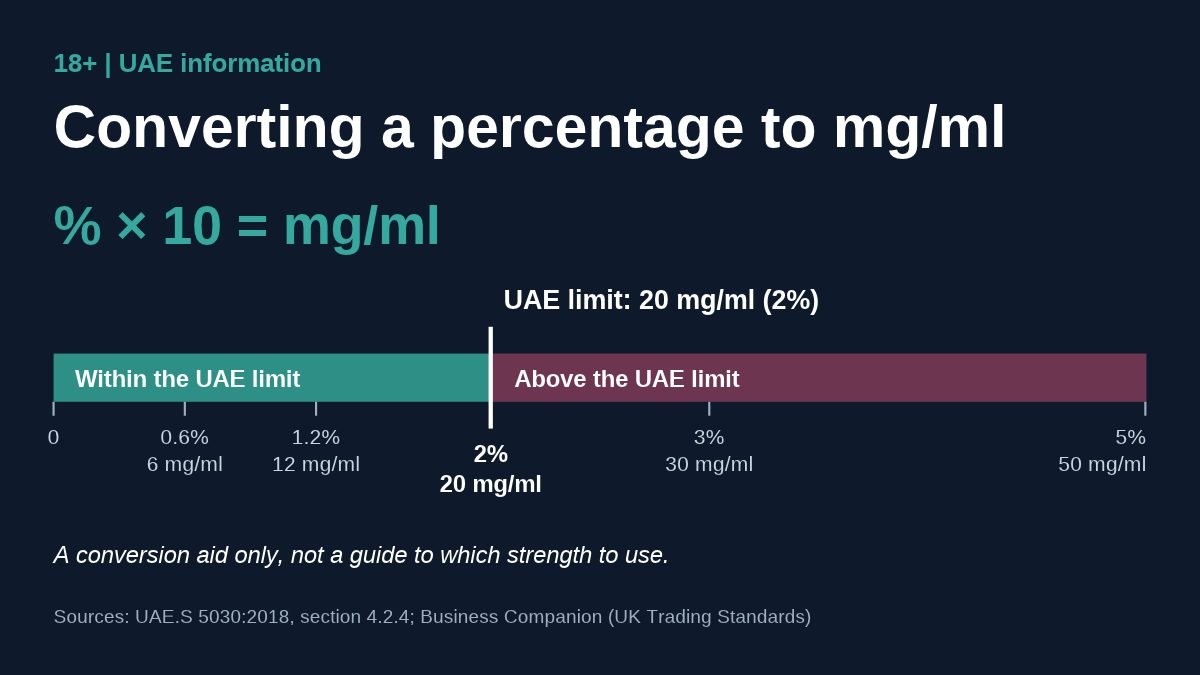
Some makers print the strength as a percentage, such as 2% or 5%. This is the same information written another way. Because one millilitre of liquid weighs roughly one gram, 1% works out at about 10 mg/ml.
In short: multiply the percentage by 10 to get mg/ml.
3. Total milligrams (mg)
A figure written as plain “mg” with no “per ml” can mean two different things. On many labels “20mg” is shorthand for 20 mg/ml. On others it describes the total nicotine in the product.
In short: to find the total yourself, multiply the strength by the volume. By that arithmetic, a 10 ml tank at 20 mg/ml holds up to 200 mg of nicotine in total, which is the most the UAE limits allow for an integrated tank.
4. Milligrams per pouch
Nicotine pouches are measured in milligrams per pouch, because there is no liquid. That figure cannot be compared directly with mg/ml. UAE.S 5030 does not cover pouches: its scope excludes “tobacco products which are consumed orally”.
In short: the 20 mg/ml limit does not apply to pouches. See what is not yet confirmed for the open questions.
If you are new to the parts of an e-liquid, our explainer on what is in vape liquid covers the base liquids and the two forms nicotine can take.
Part 2: Converting mg/ml to a percentage
5. The conversion rule
UK Trading Standards guidance sets out the conversion plainly: “20 mg/ml is 2%, 12 mg/ml is 1.2%, 6 mg/ml is 0.6% and 3 mg/ml is 0.3%”. The table below uses the same rule and shows where each figure sits against the UAE limit.
| mg/ml | Percentage | Within the UAE 20 mg/ml limit? |
|---|---|---|
| 3 mg/ml | 0.3% | نعم |
| 6 mg/ml | 0.6% | نعم |
| 12 mg/ml | 1.2% | نعم |
| 20 mg/ml | 2% | Yes, this is the maximum |
| 30 mg/ml | 3% | لا |
| 50 ملغ/مل | 5% | لا |
This table is a conversion aid only. It is not a guide to which strength anyone should use.
Worked example
A label reads 1.2%. Multiply by 10 and you get 12 mg/ml, which is within the UAE limit. A label that reads 3% works out at 30 mg/ml, which is not.
6. Why the figures are close but not exact
The “multiply by 10” rule is a close approximation. Laboratories often measure nicotine by weight (mg per gram) and then convert to mg/ml using the liquid’s density. Canada’s regulations describe exactly this step: the mg/mL figure is found by “multiplying the results of the test … expressed in mg/g, by the density of the vaping substance”.
In short: e-liquids are slightly denser than water, so a percentage by weight and a figure in mg/ml can differ a little. For reading a label, the simple rule is enough.
Part 3: The UAE 20 mg/ml limit
7. What the standard says
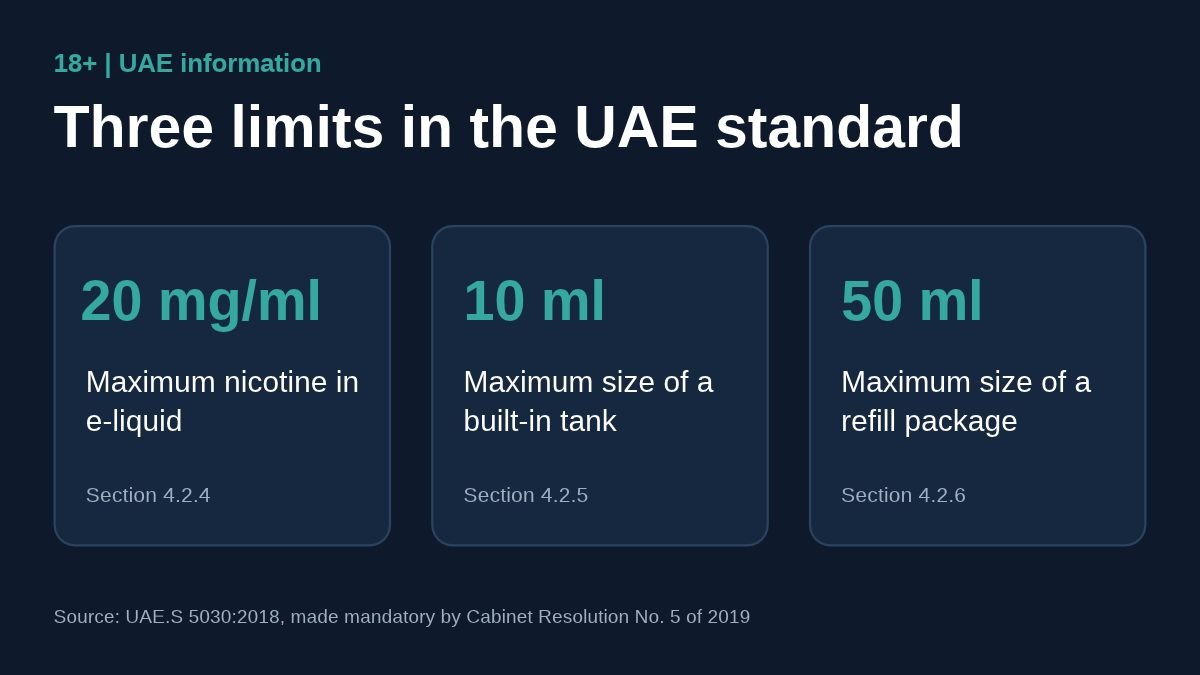
UAE.S 5030:2018, titled “Electronic Nicotine Products (Equivalents of Traditional Tobacco Products)”, sets three limits in section 4.2 (standard text):
- Nicotine (4.2.4): no more than 20 milligrams per millilitre of electronic liquid.
- Integrated tank (4.2.5): no more than 10 ml.
- Refill packages (4.2.6): no more than 50 ml per package.
The standard’s scope covers products that “may or may not contain nicotine”, so nicotine-free e-liquids fall under the same standard too.
8. How it became law
Cabinet Resolution No. 5 of 2019, issued on 6 January 2019, states that UAE.S 5030:2018 “shall be deemed a mandatory standard specification in the United Arab Emirates”. The Ministry of Industry and Advanced Technology (MoIAT) describes the standard’s aim as being “to prevent the spread of electronic cigarettes and analog products in the markets”, and links it to Federal Law No. 15 of 2009 on tobacco control.
9. Why “5%” and “50 mg” figures do not meet the UAE rule
Many products made for other markets are labelled 5%, 50 mg or 50 mg/ml. Using the conversion above, all three describe roughly 50 mg/ml, which is two and a half times the UAE ceiling.
In short: if you see “5% nicotine” in a search result or on a pack bought abroad, read it as 50 mg/ml. That figure is above the UAE limit. The age rules and the wider legal picture are covered in our guide to UAE vaping regulations.
What the pack warning says about nicotine
The UAE standard does not let a pack play down nicotine. Under section 5.2.8, the English warning reads: “Contains nicotine which causes severe addiction, increased heart rate and high blood pressure.” It goes on to say that nicotine is harmful to pregnant and nursing women and to people with chronic lung diseases.
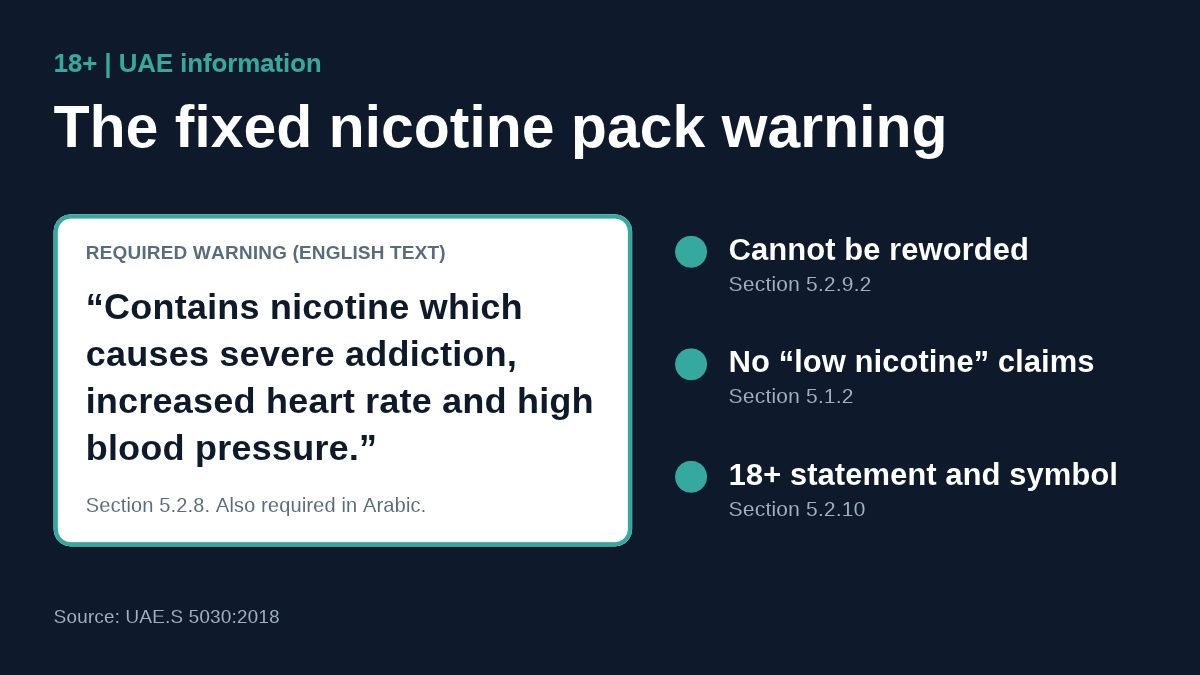
- The wording is fixed. Section 5.2.9.2 says the warning may not be changed, modified or rephrased in any way, and it must appear in Arabic and English.
- No “low nicotine” claims. Section 5.1.2 bans descriptors such as “low or no tar and/or nicotine” and any suggestion that a product carries reduced risk.
- A second warning for e-liquid. Section 5.2.11 requires products containing e-liquid to state that the product “may pose a health hazard when inhaled, swallowed or gets in contact with the skin”.
- An age statement. Every pack must also carry the 18+ statement and symbol. Our article on what an e-cigarette is also touches on this.
Nicotine and addiction: what health bodies say
A lower or higher number on a label does not change what nicotine is. The World Health Organization says plainly that “nicotine is highly addictive and harmful to health”, and that a non-smoker who uses these products may become addicted. The same WHO page notes that the products “contain varying amounts of nicotine” and that some sold as nicotine-free have been found to contain it.
In May 2026, the WHO repeated that “nicotine is highly addictive and harmful, especially at high concentrations”, with particular risk for young people whose brains are still developing.
In the UAE, the Ministry of Health and Prevention (MoHAP) has warned against promoting electronic smoking products as lower-risk alternatives to traditional cigarettes, saying there is no scientific evidence to support such claims. For that reason this article makes no comparison between strengths and cigarettes and gives no advice on which strength to use. If you want help to stop using nicotine, speak to a doctor or a government health service.
Reading a label: a short checklist
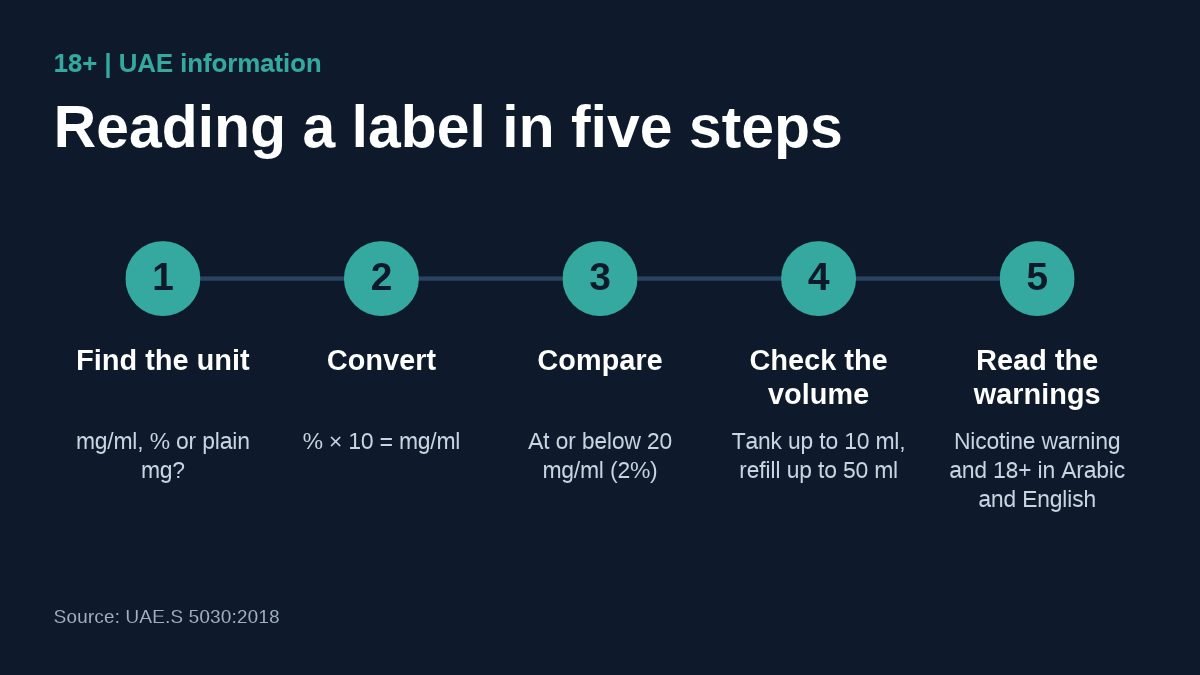
- Find the unit. Check whether the figure is in mg/ml, a percentage or plain mg.
- Convert if needed. Multiply a percentage by 10 to get mg/ml. If the label says plain mg, check whether it means per ml or the total in the product.
- Compare with the limit. A UAE-compliant e-liquid should be at or below 20 mg/ml (2%).
- Check the volume. Integrated tanks should hold no more than 10 ml and refill packs no more than 50 ml.
- Look for the warnings. The fixed nicotine warning and the 18+ statement should appear in Arabic and English.
What is not yet confirmed
Some points are not settled by the official texts we read. We will update this section when they are.
- Tolerance. UAE.S 5030 does not state how far a product’s real nicotine content may differ from the figure on its label. It asks for laboratory reports on nicotine concentration, but sets no margin.
- Printing the strength. We did not find a clause in the labelling section (5.2) that explicitly requires the nicotine figure to be printed on the pack, although the ingredients must be listed. A lawyer or MoIAT should confirm this.
- Current version of the standard. The copy of UAE.S 5030:2018 we read is hosted by a tobacco-law database, not by MoIAT. We could not find a newer official version, but one may exist.
- The GCC standard. A Gulf-wide standard, GSO 2805:2025, was adopted in 2025. When and how the UAE will apply it, and whether it changes any nicotine rule, has not been confirmed by MoIAT.
- Nicotine pouches. Pouches are outside UAE.S 5030. We have not found an official UAE source setting a maximum strength per pouch.
Frequently asked questions
What is the maximum nicotine strength in the UAE?
20 mg/ml for e-liquid, under section 4.2.4 of UAE.S 5030:2018. That is the same as 2%. The standard became mandatory through Cabinet Resolution No. 5 of 2019.
Is 20 mg the same as 2%?
Yes, when “20 mg” means 20 mg/ml. Divide mg/ml by 10 to get the percentage. If “20 mg” describes the total nicotine in a product, you need the volume as well to work out the strength.
What does 5% nicotine mean?
It means roughly 50 mg of nicotine per millilitre of liquid. That is above the UAE limit of 20 mg/ml, so a 5% e-liquid does not meet the UAE standard.
Does the standard cover nicotine-free e-liquid?
Yes. UAE.S 5030 covers products that “may or may not contain nicotine”, so the volume, labelling and ingredient rules apply to nicotine-free liquids as well.
Is a lower nicotine strength harmless?
No official source we read says so. The WHO describes nicotine as highly addictive and harmful to health, and the UAE standard bans “low nicotine” claims that suggest reduced risk.
Sources
All sources checked on 23 November 2026.
- UAE.S 5030:2018 Electronic Nicotine Products, standard text (via Tobacco Control Laws) (checked 23 November 2026)
- Cabinet Resolution No. 5 of 2019 regarding a mandatory standard specification, UAE Legislation (checked 23 November 2026)
- UAE mandatory regulation for electronic nicotine products, MoIAT (checked 23 November 2026)
- Tobacco: E-cigarettes, questions and answers, World Health Organization (checked 23 November 2026)
- WHO urges governments to protect young people from addiction to tobacco and nicotine products, 29 May 2026 (checked 23 November 2026)
- MoHAP urges smokers to quit, cautions against risks of smoking and electronic products, May 2024 (checked 23 November 2026)
- Chemical safety of vapes: GB CLP, Business Companion (Chartered Trading Standards Institute) (checked 23 November 2026)
- Nicotine Concentration in Vaping Products Regulations (SOR/2021-123), Government of Canada (checked 23 November 2026)
You might also like
- UAE Vaping Laws 2026: What the Rules Actually Say
- The UAE’s 18+ Rule for Vapes and Nicotine Products, Explained
- Where Vaping Is Banned in the UAE
- What is an E-Cigarette (Vape)
General information, not legal or medical advice.